How to Build True Digital Twins with AI Agents
Build smarter AI agents by mimicking human cognitive memory loops

Lately, a bunch of marketing buzzwords have popped up, like Loop engineering and Graph engineering. But really, these are just old software engineering practices wrapped in shiny new packaging. The core methodologies remain identical. Only the tools and platforms have changed.
Both Loop engineering and Graph engineering aim to help AI agents run autonomously within clear boundaries and long-term goals. But beneath these flashy names, a fundamental question remains: Can an AI agent truly outperform a seasoned Subject Matter Expert (SME)?
I agree that current AI agents are capable enough to handle fundamental tasks easily. However, when it comes to executing complex work inside a complex system, today’s agents lack the required intelligence. This is where loop engineering runs into real trouble. Right now, keeping a loop running smoothly requires clear goals, strict validation gates, and a smart orchestrator.
The core problem lies in that orchestrator. How smart does it actually need to be?
Loop engineering fails to solve this issue, which limits its loops to simple, intuitive tasks. The AI agents we actually want are true digital twins. They should mirror our domain knowledge and decision-making style. They need to handle the heavy mental lifting in our daily work reliably while running continuously in the background.
There is still a big gap between current LLMs and the human brain. An LLM might be a generalist, but domain experts are the specialists.
How do we close this gap for our agents? The most critical step is giving them a proper brain.
Cognitive Closed-Loop
We can explain this using a simplified human cognitive model without getting bogged down in academic jargon. If you want a deep dive into cognitive science or neuroscience, you can check standard textbooks on those subjects.
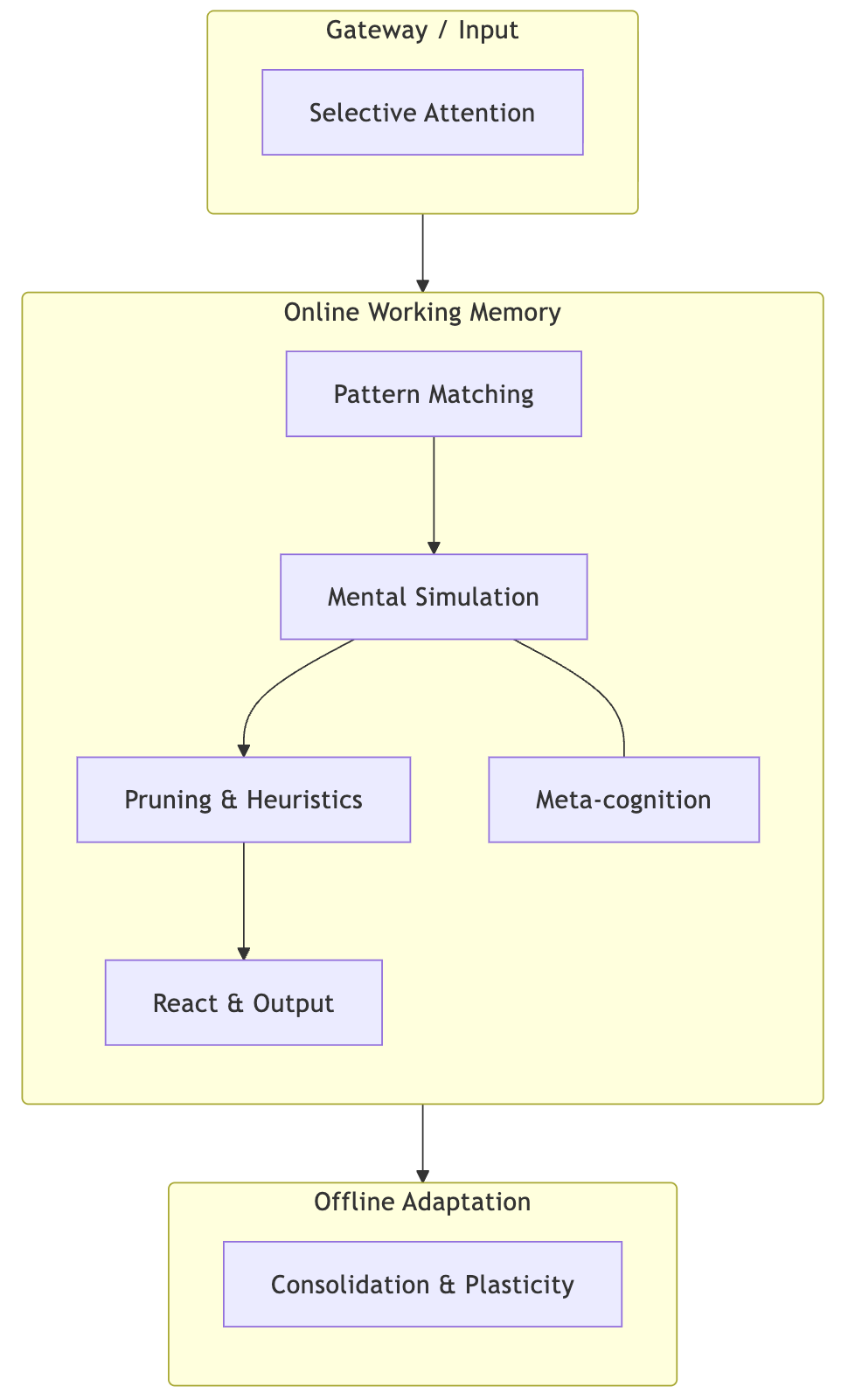
In the Selective Attention stage, our brain filters out noise and extracts key signals from massive streams of input. Otherwise, we would quickly suffer from information overload.
In the Pattern Matching stage, incoming signals trigger retrieval and prediction rather than active thinking. The brain compares inputs with past experiences to find relevant mental links.
In the Mental Simulation stage, once the brain gathers relevant material, it simulates possible outcomes and uses them to make predictions.
In the Pruning & Heuristics stage, the brain evaluates trade-offs based on past experience and discards impractical options.
In the React & Output stage, the brain takes concrete action based on the final evaluation.
Meta-cognition runs in parallel to monitor thinking processes. It produces circuit-breaker signals when needed, such as asking, Am I going in circles?
The Consolidation & Plasticity stage works asynchronously offline rather than during active thought. This is the process where short-term memory turns into long-term memory. We reflect, summarize, and digest events, creating raw material for future retrieval.
Now that we understand how the brain operates, how do we build a brain for an LLM?
First, we need a Knowledge Base (KB).
Build a KB
An LLM is a reasoning engine. It takes input, processes a reaction, and generates output. This gives us both the beginning and the end of the chain.
Cognitive steps show us that pattern matching and mental simulation form the core of mental processing. This requires a dedicated memory storage system with fast query and search capabilities.
To make an LLM accurate, we must fetch relevant material from memory and convert it into a format the model can process easily. High-quality input context is the only way to produce high-quality output results. This concept lies at the heart of context engineering. Nothing is truly new under the sun.
A Knowledge Base serves exactly this purpose.
A KB can take many shapes, ranging from Andrej Karpathy’s popular LLM wiki to traditional RAG architectures. The specific format does not matter much because both provide storage and retrieval. They simply differ in implementation details.
I previously wrote an article detailing the evolution of RAG, which you can read here.
The key requirement is storing high-quality, interconnected content. If a brain holds garbage, it will produce garbage decisions. Similarly, if memory stores isolated facts without context, decisions will suffer from narrow perspectives and blind spots.
Both quality and interconnectedness are essential.
However, high-quality data alone is not enough. Without a structured entry point, extensive knowledge remains useless theoretical noise. We also need proper classification and indexing.
Proper Categorization
Just as traditional databases rely on indexing, sharding, and partitioning for fast lookups, human memory operates on similar mechanisms.
Brain memory requires similar mechanisms. In practice, software development already relies on proven approaches like taxonomy. The taxonomy methodology acts as an externalized, standardized version of human categorization.
We can skip dense theories and explain this approach in plain language. We see the same pattern at work in human cognition.
Taxonomy relies on four core principles:
Feature Extraction: Breaking objects down into key attributes. For instance, when processing an apple, we extract attributes like Type: Fruit, Color: Red, and Texture: Crunchy.
Relational Structuring: Linking objects through logical relationships, most commonly Is-a or Part-of connections. For example, an Apple is a Fruit, and a Fruit is a Food. A Tire is part of a Car.
Controlled Vocabulary & Mapping: Establishing canonical terms while mapping slang, typos, and synonyms to those canonical terms. If a user searches for potato or spud, the underlying system maps both queries to the same category ID.
Boundary Setting / MECE Principle: A well-designed taxonomy follows the MECE principle (Mutually Exclusive, Collectively Exhaustive). This ensures every item has a clear location without falling into conflicting categories.
Cognitive psychology shows that the brain groups similar concepts automatically to conserve energy. When we see an unfamiliar dog breed, our brain immediately categorizes it as a dog rather than analyzing it as an entirely new species. Taxonomy puts this mental principle into practice.
The Final Step: Feedback Loop
The final stage of cognitive processing involves an offline background component.
During sleep cycles, the hippocampus consolidates processed daily events into experiences and writes them to long-term memory. This creates traceable paths, making future lookups faster and more thorough while enabling safer, more efficient pruning.
To maintain an effective KB, we need two write paths. Beyond asking the agent to memorize facts directly, we need an offline processing pipeline.
Continuous KB updates are the only way to provide an agent with rich, complete context.
Wrap Up
The market today is flooded with flashy tech buzzwords. But as I mentioned earlier, nothing is new under the sun. Marketing jargon simply repackages foundational concepts without altering their underlying nature.
If we want an LLM to become genuine AI with real intelligence rather than just next-token prediction, we must equip our agent with human-like cognitive loops and deep experience. Only then can an agent become truly smart.
People often conflate LLM, Agent, and AI. In reality, these represent completely different technical tiers. An LLM handles input and output. An agent adds the ability to react. But reaching true AI requires an actual cognitive brain.
In this article, we explored how to build a digital twin through the lens of cognitive science. In the next post, I will share my exact implementation step by step. Let’s call it a day.
Originally published on Medium